
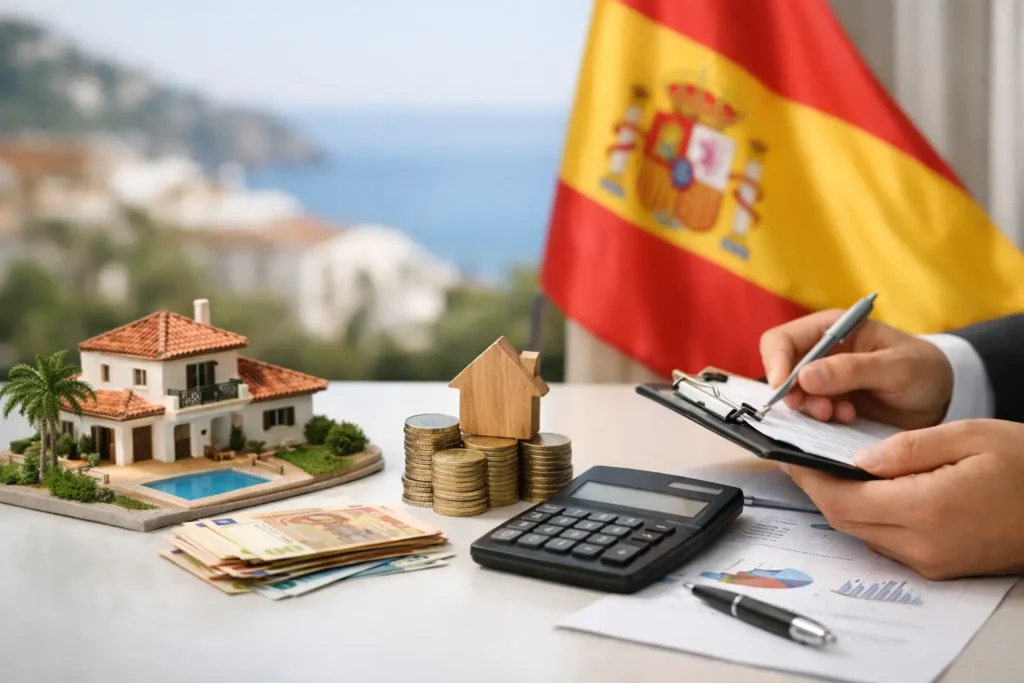
The number that catches many overseas buyers off guard is not the purchase price. It is the tax bill that appears around it. If you are researching buying property in Spain tax, you need more than a rough percentage. You need to know which tax applies, when it is paid, what changes by region, and where buyers often underestimate the true cost of purchase.
In Spain, taxes are not a small side note to the transaction. They are a central part of your budget, and they can vary depending on whether you are buying a resale home, a brand-new property from a developer, or a higher-value asset that falls into a different regional band. Add notary fees, land registry charges, legal work, and possible mortgage costs, and the gap between headline asking price and real acquisition cost becomes significant.
For that reason, smart buyers do not ask only, “What does the property cost?” They ask, “What will completion actually cost me?” That shift in thinking helps avoid last-minute surprises and leads to better decisions from the start.
Buying property in Spain tax – what you pay at purchase
The first thing to understand is that Spain does not apply one universal purchase tax to every property. The tax depends primarily on whether the property is resale or new build.
Resale property and Transfer Tax
If you buy a resale property, the main tax is Property Transfer Tax, often referred to by its Spanish initials, ITP. This is paid by the buyer. The rate is set by each autonomous region, which means it is not identical across Spain.
In some regions, the rate may be a flat percentage. In others, it can be progressive, meaning more expensive properties attract a higher rate on part or all of the purchase price. There may also be reduced rates in limited circumstances, such as for younger buyers, large families, or primary residence purchases, but overseas second-home buyers should not assume they qualify.
This regional variation matters. Two similar homes with the same price in different parts of Spain can carry different tax liabilities. Buyers often focus heavily on location, views, and resale potential, yet fail to compare transaction costs across regions. That can affect your total budget more than expected.
New build property, VAT, and stamp duty
If you buy a brand-new property from a developer, you generally do not pay ITP. Instead, you usually pay VAT, known in Spain as IVA, plus stamp duty, known as AJD.
For standard residential property, VAT is typically 10 percent of the purchase price. Stamp duty is charged separately, and the rate is also set regionally. That means the final tax cost on a new build is often higher than some buyers first assume, especially if they are comparing a developer property with a resale home without adjusting for the tax difference.
New builds may offer advantages such as energy efficiency, modern specifications, and lower short-term maintenance risk. But from a tax perspective, they need careful comparison. A buyer drawn to a cleaner, easier purchase process should still run the full numbers before deciding that new automatically means better value.
Other costs that sit alongside buying property in Spain tax
Tax is the largest extra cost, but it is not the only one. A prudent budget also allows for notary fees, land registry fees, legal representation, and administrative costs related to completion.
If you are buying with a mortgage, there may be additional expenses connected with valuation and financing. Spain has changed some rules around mortgage-related costs in recent years, but buyers should still review these carefully rather than relying on assumptions or general online estimates.
This is where overseas purchasers are often exposed. Seller-side agents may discuss the property enthusiastically but spend less time unpacking the full acquisition structure from the buyer’s perspective. Independent advice is valuable because budgeting accurately is part of protecting the purchase, not just processing it.
Regional differences can change the math
Spain is not one uniform property market, and it is not one uniform tax environment either. Andalusia, Valencia, Catalonia, Madrid, the Balearic Islands, and the Canary Islands each have their own rules, rates, and occasional concessions.
That does not mean every purchase requires a tax specialist from day one. It does mean buyers should avoid broad statements like “tax is around 10 percent” and treat them as planning shorthand only. In practice, your actual figure may be lower or higher depending on region, property type, and transaction structure.
The safest approach is to calculate based on the exact location and the exact asset. A buyer comparing Marbella with Valencia City, or Mallorca with the Costa Blanca, should not assume the same tax position applies in each case.
Annual property taxes after purchase
Many buyers focus on completion costs and forget the ongoing tax position. Yet ownership in Spain brings annual and periodic tax obligations that should be factored into affordability.
IBI and local charges
The most common annual local tax is IBI, which is similar in concept to municipal property tax. It is charged by the local town hall and is based on the property’s cadastral value rather than simple market value. The amount varies by municipality and by property.
Some properties may also involve local waste collection charges or community fees if they are part of an apartment block, urbanization, or resort complex. These are not all taxes in the strict sense, but they are recurring ownership costs and matter just as much in practical budgeting.
Non-resident income tax
If you are not tax resident in Spain and you own a property there, you may still have a non-resident tax filing obligation. Even if the home is for your own use and not rented out, Spain can apply an imputed income basis for tax purposes.
If you do rent the property, the position changes again and reporting becomes more complex. The rules differ depending on residency status and, in some cases, where the owner is resident. This is one of the areas where generic advice quickly becomes unreliable. The principle is simple enough – ownership can create tax obligations even without a sale – but the calculation depends on your circumstances.
Capital gains and seller taxes still matter to buyers
You may wonder why seller taxes matter if you are the buyer. They matter because unresolved issues, incorrect expectations, or poor transaction handling can affect negotiations and completion.
When a property is sold in Spain, the seller may face capital gains tax and municipal plusvalia tax. In cross-border cases, there can also be retention rules when the seller is non-resident. While these are not usually your taxes as buyer, they are part of the legal and financial framework around the sale.
If documentation is poor or liabilities are misunderstood, transactions can become delayed or disputed. A buyer who has proper representation is in a stronger position to see these risks early and keep the process controlled.
Common mistakes buyers make on Spain property tax
The first mistake is budgeting only for the agreed purchase price and adding a rough extra percentage without checking the actual regional rate. The second is assuming new build tax is always simpler or lighter than resale tax. It may be simpler in structure, but not necessarily cheaper.
Another frequent issue is forgetting post-completion obligations. Buyers who plan carefully for the purchase but ignore annual taxes, non-resident filings, or local charges can end up with a property that feels more expensive to hold than expected.
There is also a practical timing issue. Purchase taxes are usually payable within a set period after completion, so this is not money you can think about later. It needs to be available as part of the transaction funds.
How to plan for buying property in Spain tax properly
A sound approach starts with a fully itemized cost projection before you commit to a reservation contract. That should include the purchase tax applicable to the property type and region, notary and registry estimates, legal fees, and any mortgage-related charges.
It should also include a realistic view of annual ownership costs and any tax compliance you may face as a non-resident owner. This does not need to be overwhelming, but it does need to be accurate. Calm, informed buying usually comes from good preparation rather than fast decision-making.
For many overseas buyers, the real value of professional guidance is not just getting to completion. It is understanding the numbers early enough to choose the right property, in the right area, on terms that remain comfortable after the excitement of the purchase has passed. Firms such as Search and Survey Spain work from the buyer’s side for exactly that reason – to reduce avoidable risk and bring clarity to decisions that carry both financial and personal weight.
If you are serious about buying in Spain, treat tax as part of the property decision, not an afterthought. The right purchase is not simply the home you love. It is the one you can buy, complete, and own with full confidence in the costs attached.
Need Help? 🙂

Hi, this is Ian Mason.
If you have any questions, please feel free to contact us by clicking HERE and I’ll get back to you shortly. Thank you!
Get in touch ?