
Most buyers picture completion in Spain as a short meeting at the notary’s office. Everyone signs, the money changes hands and you leave with the keys. On the day, that is usually what happens.
What surprises people is how different the lead-up can be. At Search and Survey Spain, we guide buyers through every stage of buying a property in Spain, including completion at the notary, and no two completions are quite the same.
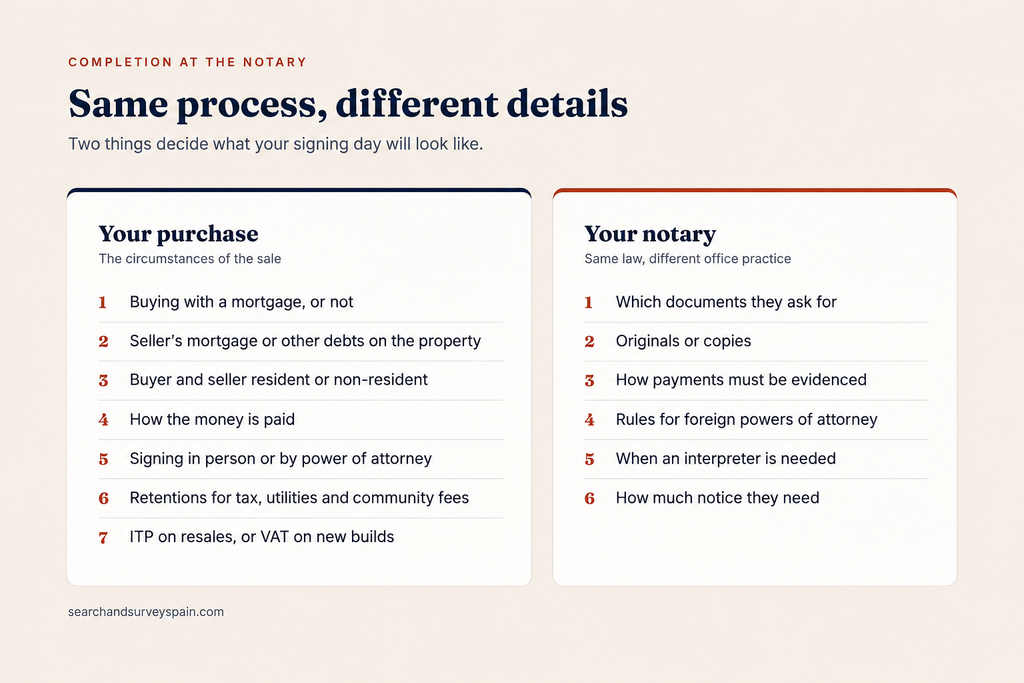
The framework is always the same, but the details change for two reasons:
- Your transaction: whether there is a mortgage or existing debt, where the buyer and seller live, how the money is paid, who attends and which tax applies.
- The notary: every notary applies the same law, but they don’t all ask for the same documents.
What always happens at the notary
A Spanish notary is a public official who acts for neither the buyer nor the seller. Their job is to make sure the sale is legal and that both parties understand what they are signing. In every purchase:
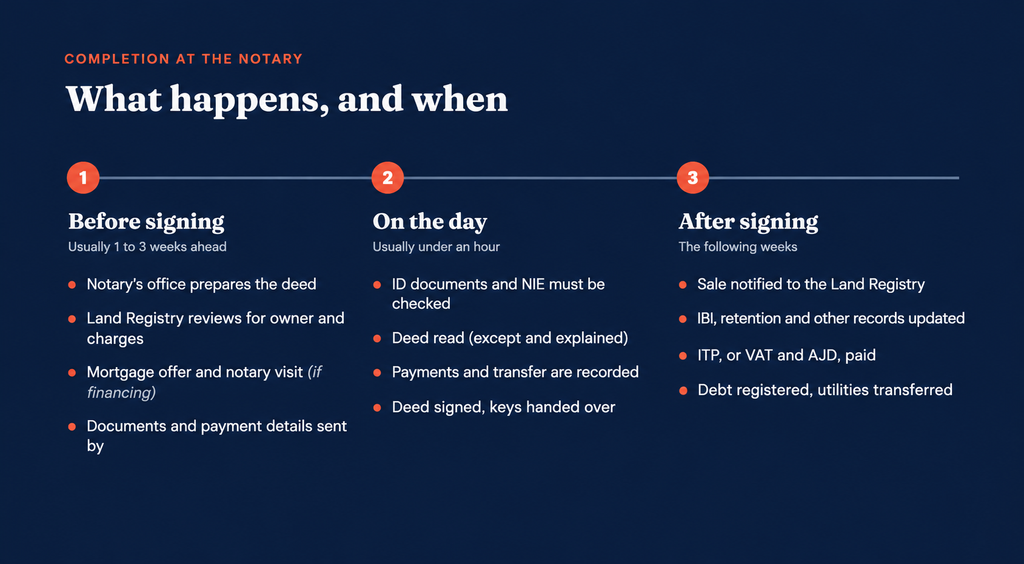
- Before signing, the notary’s office prepares the purchase deed (escritura de compraventa) and checks the Land Registry for the owner and any charges.
- On the day, the notary checks ID and NIE numbers, explains the deed and records how the price was paid. Both sides then sign.
- Afterwards, the sale is notified to the Land Registry, the tax is paid and the deed is registered in the buyer’s name. Normally all this is done by the notary but on occasions they refuse so we or a gestor will arrange.
What changes from one purchase to the next
1. Buying with a mortgage
With a Spanish mortgage, a bank representative attends and you sign two deeds: the purchase and the mortgage. Under Spain’s mortgage law, the bank must give you the binding offer (FEIN) at least 10 days before signing, and you must visit the notary beforehand so they can check you understand the loan. The bank’s timetable often decides the completion date.
2. When the seller has a mortgage or other debts
If the seller still has a mortgage, it is paid off at completion from the purchase price, with part of the money going straight to the seller’s bank. A separate cancellation deed is then needed to remove it from the Land Registry, so make sure this is covered. Any other registered debts must also be cleared.
3. Resident or non-resident buyer and seller
Buyer and seller both need an NIE. If the seller is not tax resident in Spain, the buyer must hold back 3% of the price and pay it to the Spanish Tax Agency using Modelo 211 within one month of completion. Once paid the buyer must provide the form Modelo 211 to the seller so they can apply for any appropriate refund.
The buyer can also become responsible for the seller’s plusvalía municipal (capital gain paid to local town hall) so an amount is usually held back for that too.
4. How the money is paid
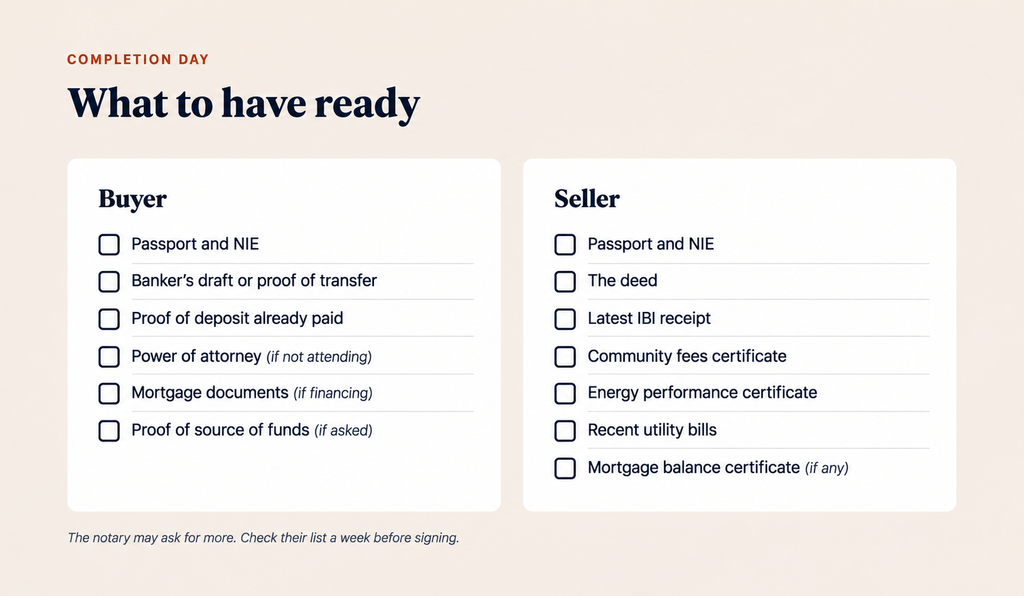
The notary must record exactly how the full price was paid, including the deposit. Most sales use a banker’s draft from a Spanish bank or a transfer on the day. If your money is coming from abroad, allow time for the transfer and for bank checks on where the funds came from.
5. Signing in person or through a power of attorney
You don’t need to be in Spain to complete. Many buyers sign through a power of attorney. One signed abroad must be notarised, apostilled and usually translated into Spanish. Send it to the notary early so they can confirm the wording covers everything. If you attend in person and don’t speak Spanish well, the notary should provide or insist on an interpreter.
6. Utilities, community fees and local taxes
Some debts pass with the property, so the seller should provide a community fees certificate, the latest IBI receipt, recent utility bills and an energy performance certificate. If anything is unpaid, an amount can be held back from the price until it is settled.
7. ITP or VAT
Resale homes pay Transfer Tax (ITP), set by each region and usually between 6% and 10%. New homes bought from a developer pay 10% VAT plus stamp duty (AJD), usually 0.5% to 1.5%. The deed can’t be registered in your name until the tax is paid.
Why two notaries may ask for different things
Every notary follows the same law, but each office works in its own way. They can differ on which documents they want and how early, whether copies are accepted, how payments must be evidenced, what they need for a foreign power of attorney and when an interpreter is required.
The fix is simple: contact the notary’s office early, ask for their list and send documents in good time. Most problems on completion day come from something that could have been checked a week earlier.
Getting ready for your completion
Completion in Spain is straightforward when everything is prepared, and stressful when it isn’t. If you are planning to buy, Search and Survey Spain can guide you through every step, from preparing your documents and checking the property to the day you sign at the notary.
Get in touch with our team to talk through your purchase.
Need Help? 🙂

Hi, this is Ian Mason.
If you have any questions, please feel free to contact us by clicking HERE and I’ll get back to you shortly. Thank you!
Get in touch ?