
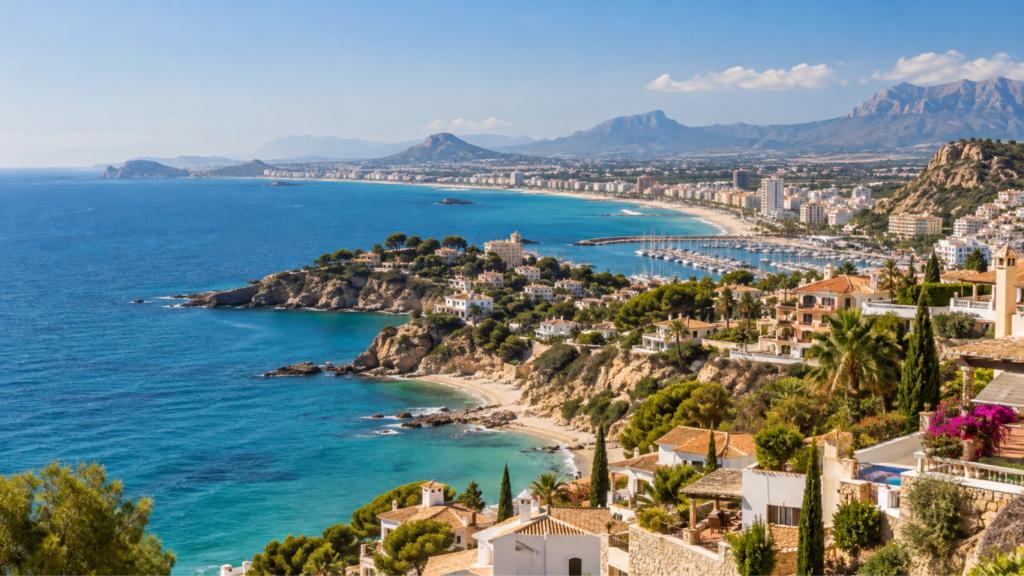
The costas are marketing names with no legal meaning and no fixed borders, but they are useful shorthand for climate, price, flight access and neighbours. Between Girona and Almería lie 1,600 kilometres, four regional governments, four sets of transfer tax rates and very different rules on holiday letting. Here is each stretch, north to south.
- Costa Brava (Girona). Beautiful coves, real Catalan character, two airports, Barcelona 90 minutes away. Against that: a short season, wet winters, high transfer tax and heavy restrictions on holiday letting.
- Maresme and Garraf (Barcelona). Commuter rail the length of the coast, and Sitges stays open all year. Expensive, with narrow beaches, and the railway often runs between town and sand. See our Barcelona property advisors page.
- Costa Dorada (Tarragona). Shallow sandy beaches, Reus airport and a clear discount on Barcelona province. Salou in August is intense, there is a petrochemical complex outside Tarragona, and fewer foreign buyers mean a slower resale market.
- Costa del Azahar (Castellón). Among the cheapest coastal property in Spain, and genuinely Spanish. Flight access is thin, several 2000s developments were left unfinished, and you will need the language.
- Costa de Valencia. A real city with an international airport, high-speed rail and excellent healthcare, and transfer tax on resales fell to 9% in June 2026. But prices have risen fast, city short-lets are tightly capped, and flood risk is real: check the mapping for the plot, not the town.
- Costa Blanca North (Dénia to Altea). Jávea, Moraira, Calpe and Albir. A mild microclimate, established international communities and strong resale liquidity. Hillside plots bring drainage and subsidence questions, private urbanizations carry hidden infrastructure liabilities, and undeclared extensions are common. A structural survey pays for itself here more than anywhere.
- Costa Blanca South (Alicante to Pilar de la Horadada). The best value on the coast: Torrevieja sat near €2,336 per square metre at the end of 2025, against roughly €3,150 in Orihuela Costa. Wide flight network, huge liquidity, everything available in English. The trade-offs are density, variable build quality and water scarcity.
- Costa Cálida (Murcia). The warmest mainland winters, a modern airport at Corvera and cheap golf-resort property. Against that: the Mar Menor’s ecological problems, repeated flooding in Los Alcázares and resorts that empty from November to March. See our Murcia property advisors page.
- Costa de Almería. The cheapest established market, 300 days of sun and the protected beaches of Cabo de Gata. But the province has a long history of homes built without valid licences: never buy rural property here without a legality check.
- Costa Tropical (Granada). Subtropical, with mountains and sea together and Granada 70 minutes inland. The market is small, beaches are mostly pebble and English-language services are limited.
- Costa del Sol (Málaga). The best connected coast, a year-round economy, deep professional infrastructure and 7% transfer tax. Also the most expensive and fastest rising, with Marbella past €5,600 per square metre, plus traffic, tighter tourist licensing and high community fees.
Note: the Costa de la Luz is Atlantic, not Mediterranean.
What matters more than the costa you pick
- Holiday letting is a municipal question. Rentals have needed a national registration number since July 2025, and owners can vote to ban tourist use in a building. Ask the administrador de fincas for a certificate before you exchange.
- The “100% tax” is still not law. Announced in January 2025 and still not voted on, so do not budget for it.
- The golden visa ended on 3 April 2025. Buying property no longer grants residency.
- Transfer tax varies by region. Andalucía 7%, the Valencian Community 9%, Catalonia higher. On €400,000, that difference alone can exceed €15,000.
- Registration is not legality. A property can sit on the Land Registry and still carry an undeclared extension or a missing occupation certificate: fixable before you buy, expensive afterwards. Hence a combined survey, legal and planning check.
How to shortlist
Pick three non-negotiables and let them narrow the map: flight frequency, English-speaking healthcare, a Spanish town or an international one, and whether you will be there in January. Then visit in the worst month: February tells you more than August ever will.
Still shortlisting, or looking at a specific property? Search and Survey Spain works only for buyers. We are not estate agents and have no stake in which property you choose. We survey the building, check the planning and legal position, and tell you what we would tell a friend.
Figures and rules were current as at September 2026. Always confirm the position for the specific municipality before you commit.
Need Help? 🙂

Hi, this is Ian Mason.
If you have any questions, please feel free to contact us by clicking HERE and I’ll get back to you shortly. Thank you!
Get in touch ?